01
Hot-dip galvanized
Matte silver grey
Immersion in molten zinc
Supply and manufacturing for industrial applications
Surface protection and performance
Processes backed by quality certificates and technical criteria for thickness, adhesion, coverage, corrosion resistance and inspection.
Technical alternatives
5 coating families
Documented quality
Coatings applied to bolts, fasteners and metal components come with quality certificates issued in accordance with the applicable technical standards and validated by qualified technical staff.
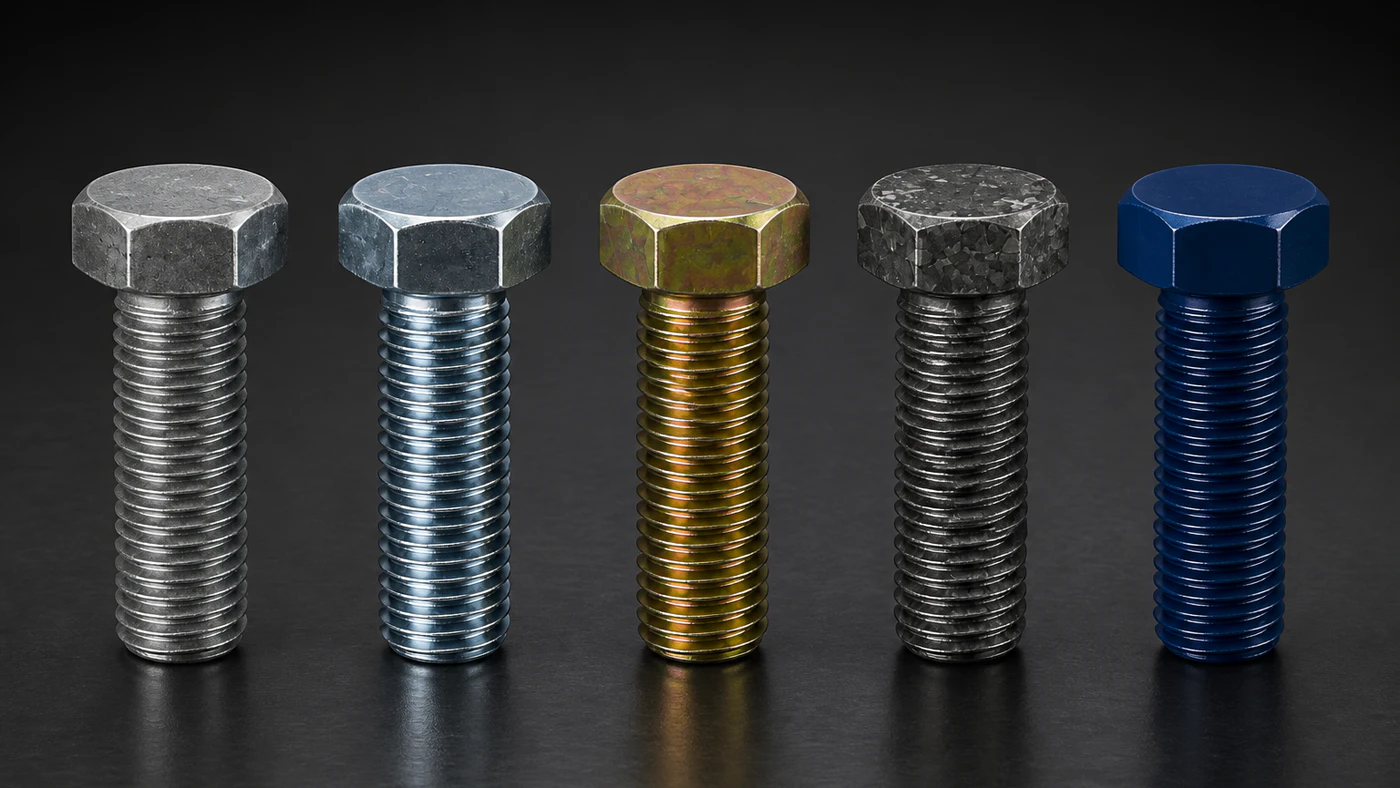
Visual guide
Appearance helps identify the system, but the final selection must answer to the real service conditions.
Matte silver grey
Immersion in molten zinc
Bright silver
Zinc electroplating
Iridescent gold
Zinc with chromate passivation
Grey with a lamellar texture
Heat-cured zinc flakes
Available in several colours
High-performance fluoropolymer
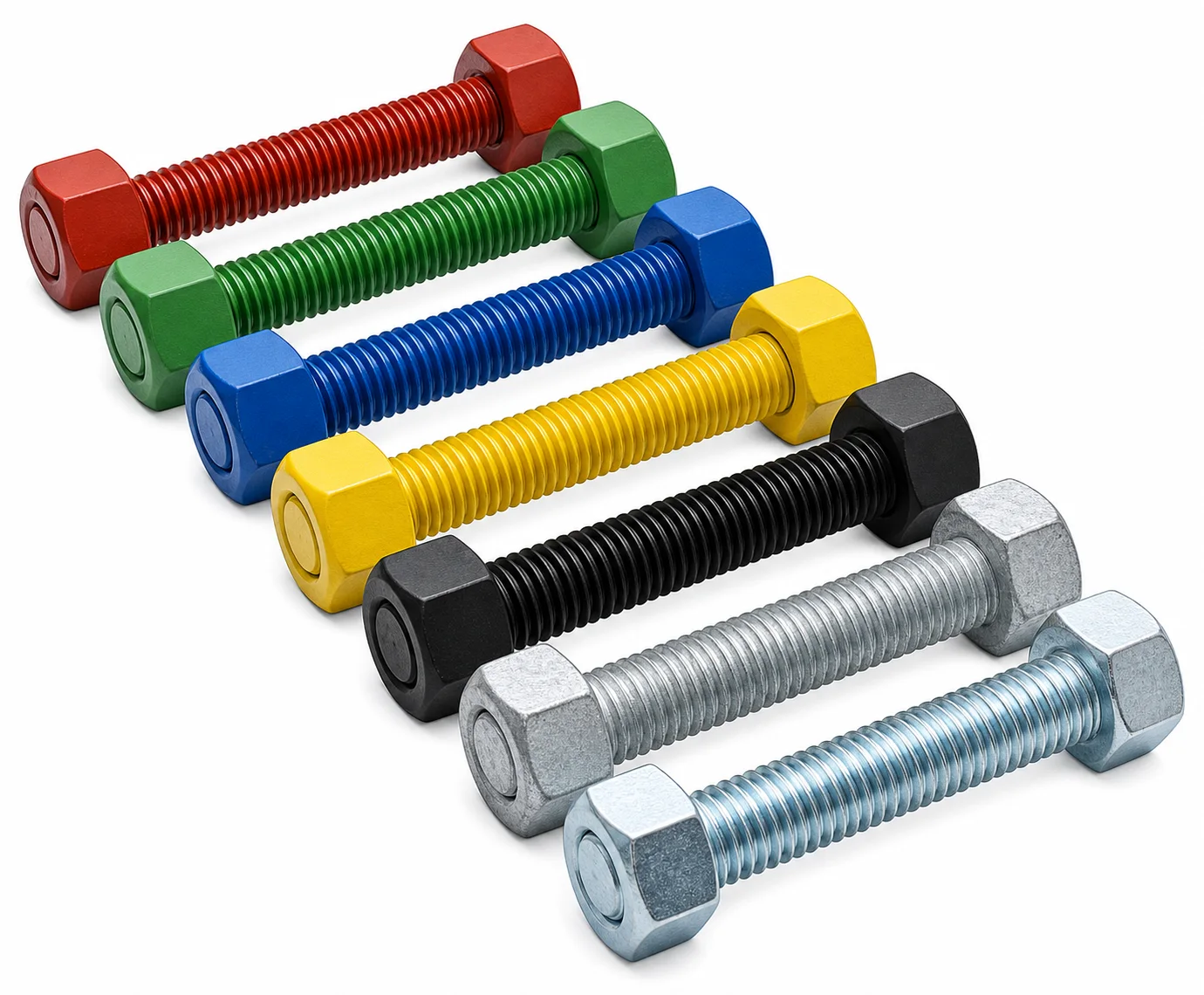
Coating comparison
Colour, protection and performance for each application.
Colour makes it easy to tell coating alternatives apart; the technical selection always depends on the real service condition.
Standards and processes
ASTM B633-23
Thin zinc coating with a smooth, bright finish. Passivation produces the characteristic iridescent yellow chromate appearance.
Indicative application
Indoor use and applications where a clean appearance and thickness control matter most; it offers less resistance to prolonged outdoor exposure.
ASTM F1941-25
Sets out requirements for electrodeposited coatings applied specifically to steel bolts, nuts and other fasteners.
Indicative application
Industrial fasteners whose coating must be documented against defined process, performance and inspection criteria.
ASTM A153-23 · ASTM F2329-23
Immersion in molten zinc followed by centrifuging to remove the excess, giving a thick, uniform layer with high corrosion resistance.
Indicative application
Standard industrial protection for outdoor use and environments with significant corrosion exposure.
ASTM F3393-24
Non-electrolytic system of zinc flakes, with or without aluminium, oven-cured to produce a uniform, highly adherent film.
Indicative application
High-strength fasteners and joints with controlled torque–tension requirements.
Heat-cured process
Combines high-performance resins with dry-film lubricants to protect against corrosion, chemical attack, wear and abrasion.
Indicative application
Applications requiring controlled friction, non-stick behaviour, anti-galling performance and durability in demanding environments.
Selection criteria
Assessing these factors makes it possible to define effective corrosion protection for the service life of the component.
Exposure environment and corrosivity category to ISO 12944.
Operating temperature and contact with chemical agents.
Material and property class of the bolt or fastener.
Applicable technical standards and expected service life of the component.
ASTM F3393-24
The non-electrolytic process is particularly relevant for high-strength fasteners and complex geometries.
Resistance of up to 5,000 hours in salt spray testing, per a specification based on ISO 12944.
Free from hydrogen embrittlement, since no electrolytic process is involved.
Uniform film on complex geometries and threads, without excessive build-up.
Controlled coefficient of friction for torque–tension requirements.
A range of colours through final layers or topcoats.
High chemical and temperature resistance, depending on the system applied.
Modern formulations free of hexavalent chromium and low in volatile organic compounds.
Critical decisions
This should not be treated as an optional decision: the environment, the strength of the fastener and the standard all shape the outcome.
The question is not only which coating looks better, but how long the bolt must last before corrosion appears in its real environment.
Choosing correctly from the start can reduce replacements, maintenance, downtime and the risk of incompatibility during installation.
A critical risk in high-strength fasteners when processes do not comply with the applicable standards and technical controls.
Coating selection
Share the material, property class, environment, temperature and expected service life. Our technical team will review the right alternative.